When I was teaching my middle school Multilingual Learners, I used several educational games to review language concepts and to extend social studies learning at the end of units. My students enjoyed the relaxed classroom atmosphere that playing games provided. Using educational games is different from gamifying lessons and in this blog post, I’ll first write about the benefits of using games and then describe the games I used with my students.
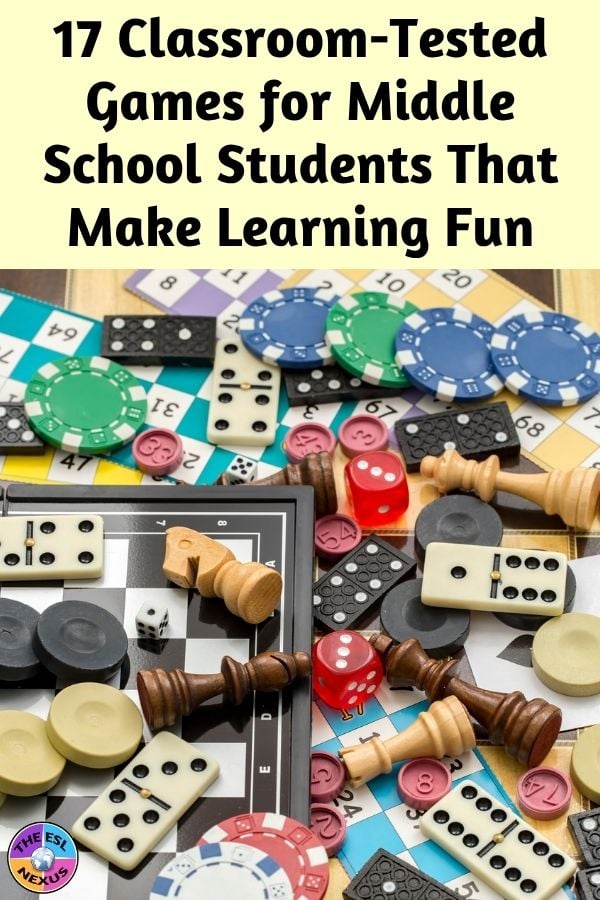
Benefits of Using Educational Games
* Games are fun. When learning is fun, students are more motivated and it’s easier to keep them engaged in the lesson.
* Learning goes deeper. When playing educational games, students actively review material which helps them better retain information.
* Students practice cooperative learning skills. Even games with two players require students to work together and that helps them develop collaboration skills.
* Games can teach both language and content: Students practice listening comprehension skills when hearing the instructions for playing a game, and they demonstrate what they learned about content subjects when playing language, social studies, match, and science games.
Educational Games for Teaching English
(This post contains affiliate links. That means that I make a small commission if you purchase one or both of the books but it’s at no additional cost to you. Thank you for your support!)
* Boggle – Using cubes with 1 letter on a cube, students have 3 minutes to write as many words as possible and only cubes whose letters touch may be used; points are given for words only 1 student has and whoever has the most points wins. For spelling and vocabulary.
* Scrabble – Using tiles with 1 letter on a tile, students use the 7 tiles they pick up to form words and place them on a board; one letter must be part of the previous student’s word and points are given for each word; whoever has the most point wins. For spelling and vocabulary.
* CHARADES – Students act out a vocabulary word without speaking or writing and other students must guess the word; can be played individually or in teams. For vocabulary.
* Pictionary – Students working in teams pick cards and draw the word on the card; other students must guess the word in a limited amount of time. For vocabulary. (I used the classic first edition but the link goes to a much cheaper newer version.)
* Around the World – Getting the Main Idea – A board game in which students read a short passage and choose the main idea from multiple choice answers; whoever travels around the board first wins. For reading comprehension.
* BINGO – Students place markers of number they hear read out loud on game boards; whoever is first to get 5 makers in a row wins. For listening comprehension. (There are websites where you can make your own Bingo cards but I haven’t used them.)
Educational Games for Teaching Social Studies
* The Royal Game of Ur – Played in Mesopotamia, 2 players use 4-sided dice to move pieces on a board with 20 squares; whoever gets all their pieces off the board first wins.
* Senet – Played in Ancient Egypt, 2 players use sticks to move pieces on a board that is a grid of 30 squares arranged in 3 rows of 10; whoever gets all their pieces off the board first wins.
* PATOLLI – Originally played in Mesoamerican Mexico, 2 students move markers across a cross-shaped board of 52 squares, using dice shaped like beans; whoever gets all their markers around and off the board first wins.
* YOTÉ – Played in West Africa, 2 students move black and white stones on a board laid out 30 squares laid in a 5-square x 6-square grid; whoever captures the most stones wins.
* MADE FOR TRADE – In this game about Colonial America with 4 different ways to play, students a) collect cards depicting items in a colonial shop or b) act as a tourist and try to get a certain amount of money or c) act as indentured servants who attempt to acquire their freedom or d) act as townsperson who wants to collect a certain number of items on a list.
An Educational Game for Teaching Math
* Yahtze – Students roll 5 dice and try to fill a score card with various number combinations using the numbers on the dice they rolled; 2 – 6 students can play and whoever has the highest score after 13 rounds wins.
Jingo
This is a game similar to Bingo but it lets students review geography and history concepts. You or students take turns reading cards with factual information and students have to guess who are what the cards describe. They put a token on the square with the correct answer and whoever gets 5 in a row first wins.
There are versions for holidays and I used the Halloween and Thanksgiving games with all my students. In my U.S. History class, I used the Great Explorers, Colonial America, and Revolutionary War versions. In my Ancient History class, students played the Ancient Egypt, Ancient Greece, Roman Empire, and Middle East versions. I also used the World Geography game when teaching that class.
My students enjoyed these games and you can find them on this website.
Other Educational Games You Can Play
* HNEFATAFL is a Viking Age strategy game in which 1 student (or team) defends a king and his guards and the other student (or team) attacks and tries to capture the king. Players move pieces on a board and the game helps develop math skills. There are different versions and my Vikings Unit Study resource includes everything you need to play the game when you’re teaching about the Viking Age.
* Parcheesi, which is the American version of a game played in Ancient India; it gives students math practice.
* CHECKERS and CHESS which help students develop math and strategic thinking skills as well as CHINESE CHECKERS and CHINESE CHESS (except that they didn’t actually originate in China) which develop the same skills.
* CARD GAMES such as gin rummy and fish which let students practice math skills.
* CONCENTRATION GAMES which help students review all kinds of academic topics depending on the words used.
Word search and crossword puzzles are 2 more types of games and I wrote about their benefits here.
Playing educational games is a great way to keep students interested and engaged in your lessons!