Using choice boards is a great way to give students more control over their learning. That doesn’t mean letting students choose what to learn; rather, it’s about giving students options for how they learn.
In this blog post, I’ll discuss what choice boards are, why they’re great for Multilingual Learners, different kinds of choice boards, offer some tips for using them, and then describe a choice board you can use as an end of year review.
What are Choice Boards?
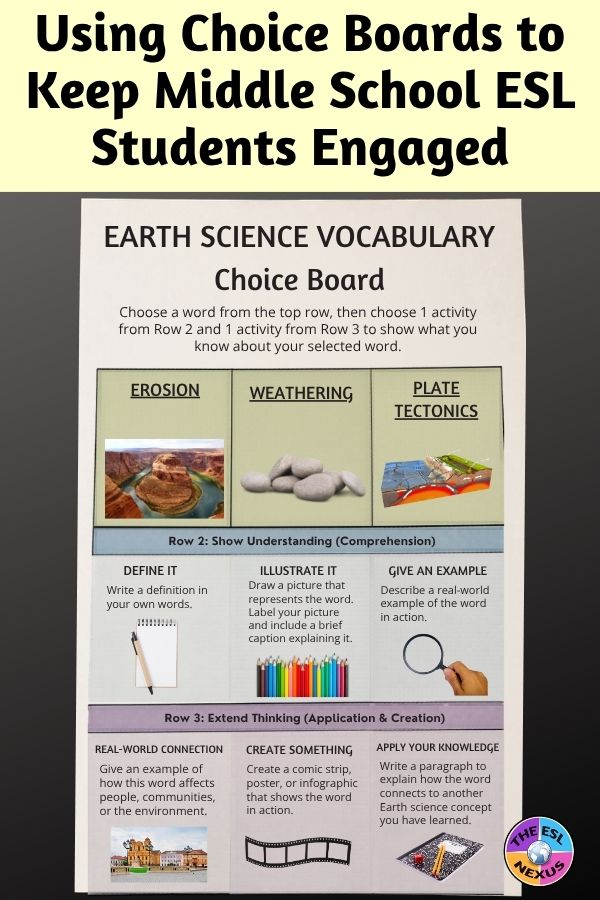
In essence, choice boards are menus that offer students alternative ways of accomplishing the same objective. They are usually presented as a grid, like a tic-tac-toe or bingo board, and inside each square is one task or activity for students to do. The difficulty of the tasks/activities usually varies and ranges from easy to more challenging.
Each task/activity is related to the student learning objectives the teacher has targeted. What makes choice boards different from other assignments is that the students themselves select what they want to do, within certain parameters. They may be told to choose one task/activity from each row or column or to just do a certain number of tasks/activities regardless of which rows or columns they’re in. It all depends on how the choice boards are designed and what you want your students to do.
In middle school classrooms, using choice boards can be especially effective because they increase student engagement and motivation. Many students enjoy having options instead of completing the exact same assignment as everyone else. For multilingual learners, choice boards can also provide opportunities to select tasks that better match their language proficiency levels, learning preferences, and confidence levels. Teachers can easily differentiate activities by including a mix of speaking, listening, reading, writing, and creative tasks.
Benefits of Using Choice Boards
There are many benefits of using choice boards in the classroom. The biggest is that differentiation is built in, which makes them ideal for classrooms with Multilingual Learners at a range of proficiency levels.
Another big benefit is that giving students control over their learning helps them stay motivated. And when students are more engaged in their learning, they will learn more.
Using choice boards also develops students’ independence. Students typically do the tasks on their own — though some activities may involve working with classmates — so they have to map out a timeline for doing them and then make sure they stay on track to finish everything. In addition, when they are responsible for deciding how to demonstrate what they’ve learned, that builds their confidence because they will select tasks and activities that interest them and which they know they can complete.
Types of Choice Boards
You can use choice boards in several ways in your classroom:
* As practice after introducing new vocabulary or grammar structures
* As writing and speaking practice
* To show understanding of an academic concept
* To show understanding of a historical time period
* As a review at the end of a unit or the school year
For example, when using them to practice new vocabulary, each task on the top row can be a new word, the middle row can be different ways of defining words (such as by giving a definition, stating its part of speech, giving synonyms and/or antonyms), and the bottom row can be different ways of using the word in context (e.g. writing a sentence, drawing a picture to illustrate it, finding a real-world connection).
If using a choice board for writing or speaking practice, the top row can be topics, the middle row can be types of writing or speaking (for example: opinion writing or a short story, a dialog or a speech), and the bottom row can be reading aloud what was written or recording it as a podcast, or presenting the work to the class as a digital or print poster.
When using choice boards to show understanding of an academic concept, the top row can name different concepts the students learned, the middle row can be ways to explain or define the concepts, and the bottom row can be ways that show how to apply a concept, create something that demonstrates understanding of a concept or teaches it to other people such as a multimedia project or picture book.
To use a choice board as a review, you can design it with just two rows. The top row can have 3 – 5 topics covered in the unit or course. The bottom row could have 3 -5 ways students can demonstrate their understanding. Ways to do that could be: create a poster, write a picture book for younger students, write an essay, create a 3-D model, or create a game about the topic.
Tips for Using Choice Boards with Students
The most important thing about using choice boards is to help students stay on track by giving them mini-deadlines and by checking in often with them. Students often need help with time management!
It’s also really helpful for students to know how their work will be evaluated. Giving them an assessment rubric or checklist when explaining the choice board activities helps students know what you’re looking for so they can make sure their work matches those requirements.
Also, while including fun activities helps keep students engaged, make sure the tasks also include enough rigor so students have to stretch themselves a little. You can provide language supports for Multilingual Learners but don’t dumb down the activities.
Try This End of Year Review Choice Board Resource
If you’re looking for a choice board that is easy to implement, my Last Week of School Activities End of Year Choice Board includes 6 activities that ask students to demonstrate what they learned during the school year. Students can either create something or write something. The tasks are differentiated to support students at various levels of English language proficiency.
This resource also has detailed directions for students and evaluation checklists for teachers to make it very easy to use during the final hectic weeks of the school year. You can use the activities in this choice board with any content class or elective class. The tasks are appropriate for both monolingual and multilingual students.
Click HERE to get this choice board.
Final Thoughts about Using Choice Boards
Using choice boards works well because they offer students a certain amount of autonomy while maintaining a structure for teachers that make them easy to implement. You can use them for many purposes and because you can design them to take into account your students’ different learning levels, they are ideal for Multilingual Learners and, in fact, all students.
If you like more info about the benefits of doing an end of year review, this blog post lists several reasons.