The 250th birthday of the United States is fast approaching! As a teacher, you might be wondering how to acknowledge this milestone with your students. The National Archives has a section called Milestone Documents, with info about the Declaration of Independence, the Constitution, the Bill of Rights, and many more. However, it doesn’t include any documents that help students learn about Juneteenth.
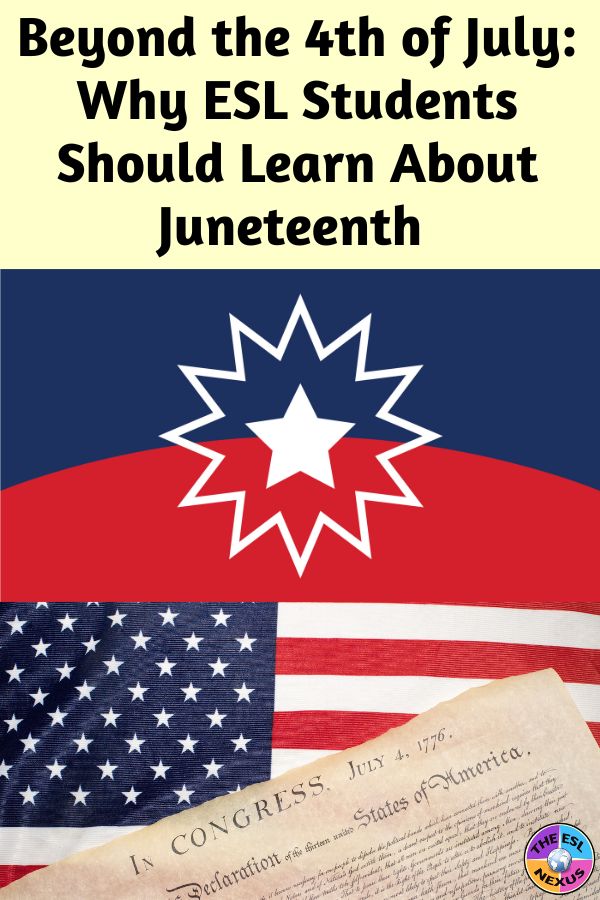
Many students, and especially Multilingual Learners (aka ELLs or ESL students) who immigrated to the U.S., may know little if anything about Juneteenth. But this is an important date in American history and deserves to be celebrated just as much as the Fourth of July.
What Is Juneteenth?
Juneteenth is the newest Federal holiday and is observed on the 19th of June each year. It commemorates the day in 1865 when enslaved people in Galveston, Texas, learned they were free.
Because even though President Abraham Lincoln issued the Emancipation Proclamation in 1863, that abolished slavery only in the Confederacy — the system of slavery continued in Texas. When General Gordon Granger of the Union Army arrived in Galveston on June 19, 1865, he announced that the people who were enslaved in Texas were now free.
That day has become known as “Juneteenth” since it combines the words of June and nineteenth. It’s been observed by Black communities for over 100 years, especially in Texas but elsewhere as well, with activities such as family reunions, community events, music, special foods, church services, parades, rodeos, and other activities that celebrate African American history and culture.
Why Is Juneteenth Important?
While the Fourth of July celebrates America’s independence from Great Britain in 1776, Juneteenth is often called the “Black Independence Day” because it celebrates the end of slavery for the African Americans who had not yet heard of their emancipation.
As the 250th anniversary of the United States nears, Juneteenth is a reminder that the history of America includes more than learning just about the Founding Fathers and the Revolutionary War. It’s a time when students should learn about the history of all the people who live and have lived in the country now called the United States.
When students learn about Juneteenth, it helps them realize that the history of this country is complex. It isn’t always easy to teach, but teaching about both the good and the bad gets students thinking about how, or if, the ideals of liberty and justice for all have changed over the past 250 years.
Why Juneteenth Matters for ELL Students
ESL students need to learn about Juneteenth because it helps them to:
* Build background knowledge about American history.
* Learn important vocabulary that’s useful for Social Studies.
* Participate in discussions about freedom, equality, and citizenship.
* Make connections between historical events and current holidays.
* Develop reading, writing, speaking, and listening skills through meaningful content.
And learning about this holiday also helps students better understand the history of African Americans in the U.S., the end of slavery, and their struggle for civil rights in this country.
Teaching Juneteenth Vocabulary
Words such as emancipation, enslaved, equality, proclamation, independence, Union, and Confederacy are high level (Tier 3) academic words. Explicitly teaching key vocabulary before students learn about Juneteenth is an easy way to support English Learners when teaching about the holiday.
Helping your students understand these vocab words makes them better prepared to comprehend any reading passages you give them about Juneteenth and makes it easier for them to participate in classroom discussions.
You can their extend learning by having your students:
* Define and illustrate the vocabulary words.
* Use the vocabulary words in sentences.
* Discuss what freedom and equality mean.
* Research historical figures such as Abraham Lincoln or General Granger.
* Write paragraphs explaining the significance of Juneteenth.
A Juneteenth Lesson Idea for Busy Teachers
If you’re looking for an easy way to teach Juneteenth vocabulary, I created a Juneteenth Crossword and Wordsearch Puzzles resource that helps middle school students learn about Juneteenth, including English Learners.
The resource includes:
* 20 vocabulary terms related to Juneteenth.
* 1 Juneteenth crossword puzzle with a word bank; clues are definitions of the vocab words.
* 3 Juneteenth word search puzzles at different difficulty levels.
* Answer keys for all the puzzles.
* Print and Google Slides™ versions of all 4 puzzles.
Because all the puzzles use the same 20 vocabulary words, students get repeated exposure to them as they practice reading and word recognition skills.
You can use these puzzles as:
* Introductory Juneteenth activities.
* Early finisher work.
* Literacy center activities.
* Homework assignments.
* Sub plans.
The leveled word searches and the crossword word bank provide extra support for students who may be encountering this content for the first time.
Click HERE for more information and to purchase this resource.
Looking Ahead to America 250
If you are discussing the upcoming 250th birthday of the United States with your students and teaching about the American Revolution, its ideals, and the events that occurred in the centuries that followed, then teaching about Juneteenth needs to be included so students learn a more complete picture of the nation’s history.
Juneteenth, also called “Freedom Day” or “Emancipation Day,” is an integral part of American history. Both the 4th of July and Juneteenth holidays celebrate freedom but they deal with different time periods. Helping your students learn about Juneteenth is an excellent way to help your students understand how the concept of freedom has evolved over time in the United States.
You can find links to additional materials that help students learn about Juneteenth in this blog post.