Every Wednesday and Friday morning at 6:00am, I join Victoria in teaching Ukrainian high school students participating in an online summer English language and American culture club. Victoria is an English teacher in Ukraine and my counterpart. Together, we collaborate over more than 6,000 miles to plan and teach our lessons.
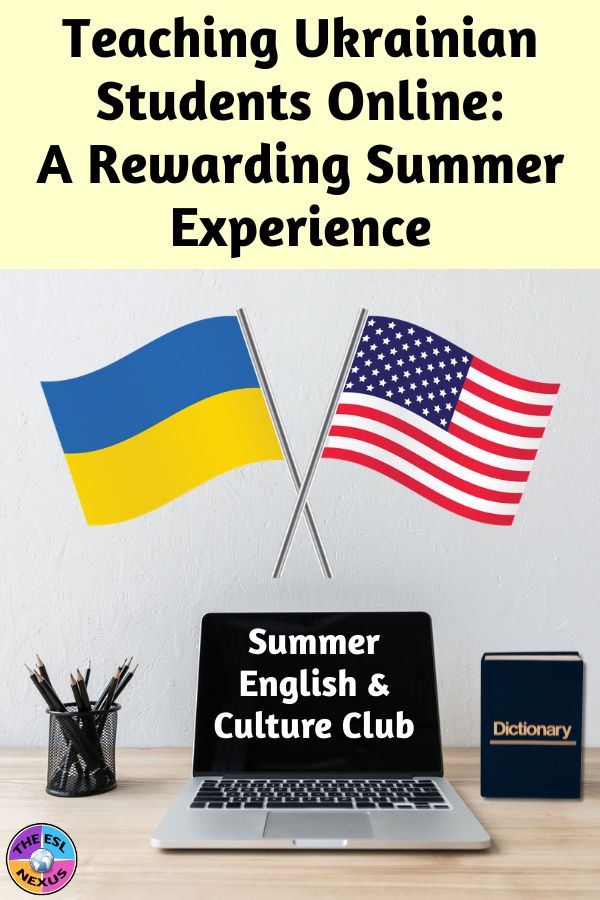
The goal of the club is to help students develop their English language skills and learn more about U.S. American culture and society. The students chose to be part of the summer club so they are highly motivated. Having now taught 4 of the 8 scheduled sessions, I can say this is one of the most rewarding and interesting teaching experiences I’ve ever had.
I’m going to describe my experience below but the views and opinions in this blog post are mine alone and do not represent those of the Peace Corps, which is the organization that has made this opportunity available.
Victoria is also going to share her perspective about the summer club.
How I Became Involved in Teaching Ukrainian High School Students
Back in 2020, the Peace Corps launched the Virtual Service Pilot program. Originally intended to virtually connect Peace Corps Volunteers who were evacuated back to the U.S. during the Covid-19 pandemic with their host country communities, the program has since expanded in its scope. Now, Virtual Service Pilot Participants (VSPPs), as the Americans who participate are called, don’t have to have prior Peace Corps experience but all the projects are still implemented remotely.
As a Returned Peace Corps Volunteer, I was aware of the program and had seen announcements posted about opportunities to be a VSPP. You can read more about the Virtual Service Pilot program and learn about engagement opportunities in education, youth in development, environment, health, and community economic development sectors on the Peace Corps website.
I was interested in doing this but whenever I looked at the announcements for upcoming engagements, they always seemed to be for at least 6 months in duration and a weekly time commitment that was more than I could manage. Plus, there was always a big time difference between me in Arizona and the other countries.
But this past April, I saw an announcement for an engagement that involved co-teaching Ukrainian high school students participating in a summer language and culture club. As someone who’s spent many years teaching Multilingual Learners, I thought this was something I could do.
Also, since many of my ancestors came from places that are now within the borders of modern Ukraine, which I wrote about here, I was drawn to this particular opportunity.
So I sent in an expression of interest and was accepted. I met Victoria, my counterpart and co-teacher, at an orientation in May. We started planning the lessons and implemented the first one in early June.
What Teaching Ukrainian High School Students Remotely Looks Like
We co-teach 2 lessons every week and each class lasts 1 hour. There are 15 – 18 students in the sessions; the number depends on who can make it each time.
Our lessons focus on topics about U.S. American culture and high school student life. When we met for the first time, Victoria suggested topics that she thought would be of interest. Because she has taught these students, she knows them well. She’s given me very helpful background information about them and offered suggestions that make the lessons go more smoothly. And during the sessions, she encourages the quieter students to contribute to the whole group discussions.
We selected 8 topics from the list Victoria developed, based on her knowledge of the students’ interests and needs and her experience teaching Ukrainian high school students. For each topic, I develop draft activities and materials, then together we refine them. Every week, we discuss over Zoom and text on WhatsApp to finalize the lessons. I then type up and send everything to Victoria so she has all the materials.
Before each lesson, we meet for 10 – 15 minutes to touch base about how we’ll implement the activities. Then, after the lesson, we stay on Zoom and do an informal evaluation of how things went and to talk briefly about the next lesson.
Each class includes both language and content objectives. The first session was introducing ourselves to each other and then the students had the chance to ask me questions about myself. It was really interesting to find out what their interests are and what kinds of careers they want to pursue. This activity also helped me get a sense of their English language proficiency.
After that, we taught a lesson about Growth Mindset and how making a mistake or failing at something should be viewed as an opportunity, not a negative experience. The goal of that lesson was to build up the students’ confidence so they wouldn’t be shy about talking with me. The third session was about the 5 regions of the United States. The fourth session was about types of community service that American high school students do and why they do it.
Here’s how Victoria described the classes we’ve taught so far:
“My main goal was to give these high schoolers a space to speak without fear. The lesson Susan taught on Growth Mindset was a real turning point — it taught them that making mistakes is just a step toward success, not a failure. Watching the quieter students find their voices and see everyone actively participating has been the greatest reward. Technology brought us together, but our shared passion for education is what made this summer unforgettable.”
Future lessons will be about holidays — students chose 3 holidays they wanted to learn about in a poll I created — plus regional American foods and careers. We also gave students the chance to pick a topic they were interested in and asked them to do another poll to let us know. Out of 5 potential topics, a majority of students selected Native Americans. It’ll be fun teaching Ukrainian high school students about Indigenous people in the U.S.
Goals for the English Language and Culture Club
Victoria told me her students don’t have much opportunity to talk with native English speakers. She said she wanted to participate in this program so she could give her students the chance to develop their language skills and hear American English since they are more used to British English. The summer club gives the students the opportunity to do that in authentic conversations.
Another goal is to help the students learn about aspects of the U.S. they may not read about in their regular English or Social Studies classes. According to Victoria, Ukrainian students don’t learn about the regions of the U.S. and they don’t do community service like American high students often do, so our classes on those topics presented information that was new to them. For the session about regions, the task for the students was to create a travel brochure and include 3 attractions to visit — the groups for the West and Southwest both mentioned things to do with cowboys.
As Victoria put it:
“What started as an online classroom beautifully transformed into a bridge across the world. For my students, this club became a pathway to the world beyond their standard textbooks. They are used to British English, so having authentic conversations with a native speaker completely transformed their confidence. They didn’t just practice the language; they discovered entirely new concepts like American volunteer culture and geographical regions. Seeing them design travel brochures and enthusiastically plan community service projects proved how deeply motivated they are to learn and grow.”
Victoria told me that she wants to practice using English and learn about American culture, too. As an English teacher, her language skills are already excellent but I’m glad to converse with her and help her maintain her language proficiency. As I share info about the U.S. with her, she is also answering my questions about Ukraine. In addition to discussing our lessons, we also find time to chat about other topics of mutual interest.
One more goal is to make the lessons replicable. That is, the lessons should be easy to implement. That way, Victoria can teach them to other students when I am not present. To that end, in addition to the actual lesson plans, we create all the worksheets and handouts for students as well as supplemental resources related to the lessons.
Challenges When Teaching Ukrainian High School Students
Of course, as in all teaching situations, there are also some challenges.
The main challenge is time. One hour goes by very quickly!
Especially when we are relying on technology when teaching Ukrainian high school students. We use breakout rooms on Zoom and in the first couple sessions, things didn’t always go as well as planned. That was a challenge at first but we’ve overcome those issues now.
Time is a challenge in another way, too: There is a 10-hour time difference between Ukraine and Arizona. The summer club meets from 4:00 – 5:00pm Ukraine time, which is 6:00 – 7:00am my time. Since I’m not really a morning person, it’s been a bit of an adjustment getting up that early.
What Makes This Virtual Service Pilot Program So Rewarding
But it’s totally worth it!
I’m so energized during each lesson because the students are amazing. They’re very motivated and engaged during the classes and ask great questions. For example, during our Introductions session, one student asked me what I like most about living in America. That was a fantastic question and I had to think for a moment before answering. I replied that it might be the fact that we have a lot of opportunities in the U.S. that aren’t always available in other countries.
The work the students produce when doing small group activities is excellent. They are very polite and need little oversight when they’re in breakout rooms. In the session about community service, each small group devised a plan for how to encourage high schoolers to participate in a volunteer program in their community. They are posting their plans in the WhatsApp group chat that Victoria set up.
I’m also learning a lot from my counterpart, Victoria. As we converse in English, I am finding out what it’s like to be a teacher who is teaching Ukrainian high school students. We’ve discovered that we have a lot in common as teachers, which is really interesting.
Final Thoughts about Teaching Ukrainian High School Students
Participating in the Peace Corps Virtual Service Pilot program has allowed me to contribute my skills in ways that not so long ago wouldn’t have been possible. Technology allows me to donate my time and use my expertise in teaching Multilingual Learners without having to leave my home. Zoom and WhatsApp enable me to collaborate with a counterpart halfway around the world and co-teach a group of students that would’ve been inconceivable decades ago.
We have only 4 more lessons to go in the summer English language and American culture camp. I’m so glad I was matched with Victoria because it’s an honor to collaborate with her and I hope the partnership we’ve established will continue long after the Virtual Service Pilot program has ended.
Victoria summed up our experience this way:
“Co-teaching across a 10-hour time difference and 6,000 miles seemed challenging at first. But our weekly brainstorming sessions and WhatsApp chats made the distance disappear. We didn’t just teach lessons; we created a complete library of worksheets and resources that I can replicate with future students. This partnership has been a wonderful opportunity for me to maintain my own language proficiency and share insights about Ukraine, making it a truly rewarding exchange. This camp proved that language is much more than just grammar rules — it is a powerful connection between people and cultures. Thanks, Susan, for such an inspiring beginning of our summer holidays!!!”
And many thanks to you, Victoria, and your students for making this such a wonderful collaboration!