One of the things I most enjoyed about teaching Multilingual Learners was the family engagement that resulted. Some teachers may hesitate about initiating and maintaining contact with their students’ families because it takes effort and language barriers can make it challenging. But the rewards of establishing positive relationships are well worth it. In this blog post, I’m sharing recommendations for 2 books that discuss how you can increase family engagement.

What Does Family Engagement Mean?
Family engagement is about getting the families of students involved in school affairs and helping them to support their children’s learning. It means that teachers work with the families of their students to advance their education. It means that teachers and families are partners with the shared goal of working to ensure the students succeed in school.
Family engagement includes everything from contacting parents and caregivers regularly by phone/text/email/notes home to coming in for conferences and open houses. Other ways of engaging families include volunteering in the classroom or chaperoning a field trip, giving presentations about their culture to the class or school community, and/or attending parent-teacher meetings or multicultural celebrations or family literacy and math nights, and more.
Research has shown that when families get involved in their children’s education, the students do better academically and have better attendance. More family engagement also helps you, the teacher, because when you know your students’ families better, parents and caregivers are more supportive and that means you can more effectively help your students find success in school.
Book Recommendations about Family Engagement
But how can you increase family engagement, especially when dealing with families whose languages you don’t know or who may not know English well enough to communicate with you? Here are 2 books I read recently that offer a multitude of ideas. They’re short, easy to read, and present lots of ideas for getting families more involved. Please click on the book titles for more info about each book and to purchase them.
(This post contains affiliate links. That means that I make a small commission if you purchase one or both of the books but it’s at no additional cost to you. Thank you for your support!)
Engaging the Families of ELs and Immigrants
(By Renee Rubin, Michelle H. Abrego, and John A. Sutterby; 161 pages, copyright 2021; ISBN 978-0367607548)
This is a great book for anyone wondering how to increase family engagement in your school. It uses an asset-based approach on how to increase family engagement. There is a wealth of information in this readable book.
The 10 chapters cover topics such as: Finding Out What Families Want, Creating a Welcoming School Environment, Communicating with Immigrant Families, Beyond Open Houses, Partnering with Families of Students with Special Needs, Immigrant Families Under Stress, and more. Each chapter opens with a scenario – an anecdote that represents the issues to be discussed.
After that, there’s a section that goes deeper into the issues raised. That’s followed by a section that relates the issues to the school context. Activities you can implement that address the issues raised are also included. Each chapter includes between 2 – 6 activities, except for the last chapter which has only one. These activities are presented in a simple lesson plan-type format.
Every chapter ends the same way. First, Relevant Literature describes 2 or 3 books that provide background about the focus of the chapter. What’s nice is that these are labeled as picture or chapter books and consequently give a different perspective about the issues. Every chapter also includes a bibliography if you want to read further.
Why I recommend this book: The issues are dealt with in a comprehensive manner and there’s depth as well as breadth. It asks thought-provoking questions. The chapters about working with families of special needs children and families under stress are particularly informative. The book discusses some legal issues but since it was published a few years ago, some of the info is now out of date; however, don’t let that detract you from the overall usefulness of information provided.
Multicultural Partnerships: Involve All Families
(By Darcy J. Hutchins et. al.; 146 pages; copyright 2012; ISBN 978-1596672109)
The 11 chapters in this practice-oriented book are divided into 4 parts: An Introduction, Multicultural Family Nights, Workshops for Parents, and Curriculum Connections. An Appendix is also included. Within Parts 2 – 4, each of the 2 or 3 chapters offers background information, a featured activity describing how one school did it, suggestions to keep in mind when implementing the activity, and then detailed instructions for replicating the activities that promote family engagement. The book is aimed at elementary and middle school teachers but I think some activities can be used at the high school level and, certainly, the theory about the importance of family engagement also applies to high school students and their families.
Chapters 1 and 2 offer general info about the benefits of increasing family engagement. Chapters 2 – 4 describe different types of activities and include step-by-step directions for doing them. The Appendix has 5 photocopiable forms, 1 of which is in Spanish, to help you organize activities and keep track of participants. The 3-page bibliography lists numerous resources for further reading.
Activities run the gamut from showcasing literature, art, and dance from other countries, to creating art projects, to teaching people how to play games from other countries. Other activities include discussing how to improve communication between your school and families, comparing and contrasting the school experience in the U.S. and other countries, and various types of workshops designed to help families become more familiar with their children’s school and the wider community they live in. The chapter on Curriculum Connections shares 2 Social Studies and Math activities that foster family engagement.
Why I recommend this book: This book is a how-to manual. Although there is some theory included at the start of each chapter, the focus is on how you can implement these activities yourself. What’s especially helpful are all the reproducibles included for the activities, which you can freely photocopy without worrying about violating copyright. What’s also great is that many of the worksheets are in Spanish, saving you the time and effort of getting them translated.
Resource for Increasing Family Engagement
An easy way to increase family engagement is to send home reports on a regular basis about students’ progress. Using this Weekly Progress Report Form lets you do exactly that. It’s in English and Spanish, in print and digital versions, and takes only 1-2 minutes to fill out per student. Click HERE to get this resource.
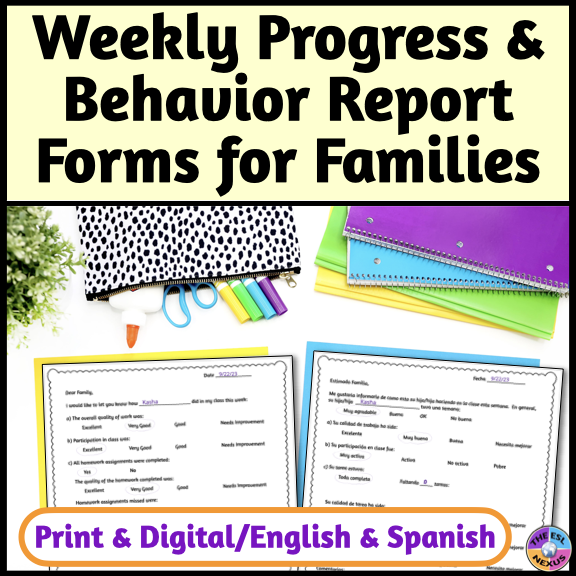
One happy educator, Laura, said about it: A great resource to keep parents involved. Thank you!
I completed the form for all my middle school students and sent them home on Friday, to be signed and returned the following Monday. I saved them in a binder and during conferences used them to show parents and caregivers the progress their children had made. Families got used to getting them and when I didn’t send them home as expected – because of a shortened week, for example – some parents actually contacted me to find out what happened. Talk about great family engagement!
If you’d like to see more professional development books recommendations, this blog post discusses 2 books about implementing rigor in the classroom. And this blog post presents an immigrant parent’s perspective about her experience with U. S. schools — it’s enlightening to read her thoughts.